

Infertility caused by thin endometrium remains a major problem in assisted reproductive technology and is often associated with low success rates after assisted reproductive technology treatment. There is a lack of consensus in the field regarding both diagnostic criteria and clinical management.
Currently available treatment options are few and their effectiveness is limited. However, recent advances in cell therapy and bioengineering have shown promising results in the treatment of thin endometrium. Notably, these new interventions have demonstrated the ability to increase endometrial thickness, restore endometrial function, and improve reproductive outcomes.
In this comprehensive review, we focus on critically evaluating these new therapeutic strategies for thin endometrium, including stem cell-derived exosomes, stem cells, and bioengineering-based approaches. By summarizing the results of available clinical trials, we highlight the promising results achieved to date and emphasize the importance of robust clinical trials to evaluate the safety and effectiveness of these interventions in the future.
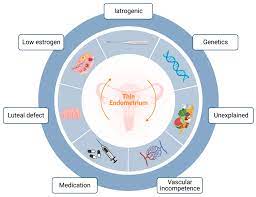
Infertility caused by thin endometrium is a difficult disease to treat and is often associated with low success rates and poorer reproductive outcomes with assisted reproductive technology. An endometrial thickness of at least 7 mm is generally considered more suitable for successful embryo implantation.
The etiology of thin endometrium is complex, varied and often unknown, making it difficult to treat these patients and study the underlying pathological mechanisms. Suspected causes of thin endometrium include Asherman’s syndrome and previous intrauterine surgeries including abrupt curettage, pelvic radiation, genetics, impaired uterine blood flow, and acute or chronic endometrial infection.
Moreover, it is associated with low estrogen levels or impaired estrogen signaling resulting from estrogen receptor dysfunction. A recent single-cell RNA sequencing study found that cellular senescence in the stroma and epithelium, together with excess collagen deposition around blood vessels, leads to endometrial thinning.
Traditional treatments, including estradiol or combination hormone therapy, growth hormone, have shown limited and inconsistent effectiveness in enlarging the endometrium and restoring function. Consequently, there is a growing demand for new treatments. In recent years, cell therapy and other innovative treatment options have emerged as promising strategies in various fields of medicine. Given the encouraging results of numerous experimental studies, these new approaches may have great potential as treatment options for thin endometrium.
Stem cell therapy has developed rapidly over the past decades and has been used to treat a variety of diseases.

Stem cells have unique characteristics such as high self-renewal capacity and the ability to differentiate into multiple cell types. Stem cell therapy has emerged as a promising avenue in reproductive medicine, offering the potential to restore endometrial function in patients with thin endometrium. Various types of stem cells have been tested in the treatment of thin endometrium in several clinical studies, demonstrating that stem cell therapy has significant potential in restoring endometrial function, including improving endometrial receptivity, implantation rates, pregnancy rates, and live birth rates.
MESENCHYMAL STEM CELLS
Unlike other sources of stem cells, umbilical cord mesenchymal stem cells stand out as a highly promising source of cells for cell therapy due to their abundance, consistent nature, painless collection procedure, and rapid self-renewal properties. . Of particular note is the fact that they show little or undetectable HLA class I expression, suggesting the possibility of allograft transplantation without the need for immunosuppression. This unique characteristic increases the attractiveness of this biomaterial as a viable therapeutic option.
In 2020, as part of clinical studies, MSCs were implanted into biodegradable collagen scaffolds into the uterine cavity of 26 patients with recurrent intrauterine adhesions, which led to an increase in the endometrium in all cases from 4.46 ± 0.85 to 5.74 ± 1.2 mm ( p < 0.01). which is associated with pregnancy in 10 women (38%), 8 of whom resulted in live births.
Subsequently, another study in 2021 involved 16 infertile women with refractory thin endometrium. MSCs were transplanted into the uterine cavity during two consecutive menstrual cycles.
After three months, the endometrium had increased from 4.08 ± 0.26 mm to 5.87 ± 0.77 mm (p < 0.001), resulting in a pregnancy rate of 31% and a live birth rate of 12%.Further histological analysis showed increased microvascular density and activation of Ki67, estrogen receptor alpha and progesterone receptors, indicating improved endometrial angiogenesis, proliferation and hormonal response.
STROMAL CELLS
Several other sources of stem cells have also been presented and have emerged as potential sources for the treatment of thin endometrium. One such source is stromal cells, which are a mixed population of mesenchymal stem cells and stromal fibroblasts.
In 2018, stromal cells were transplanted into the uterine cavity. There was a significant increase in endometrial thickness up to 7 mm in five out of seven cases, as well as successful pregnancy in two out of four women. However, this source of stem cells has certain limitations, for example, it is not suitable for patients with hypomenorrhea. These cells can significantly restore the structure and functionality of severely damaged uterine horns.
EXOSOMES
Stem cells have the ability to secrete a wide range of regenerative cytokines, and these cellular secretions are thought to contribute to the positive therapeutic effects observed in various diseases. Extracellular vesicles are an important component of these secretions, which have cytoprotective, anti-apoptotic and angiogenic effects on damaged tissues and may promote progenitor return and stem cells.
In 2020, adipose mesenchymal stem cell-derived exosomes were found to be able to maintain normal uterine structure, stimulate endometrial regeneration, support collagen remodeling, and increase the expression of endometrial receptivity markers, including β3 integrin, LIF, and VEGF. It also helps restore the endometrium after damage. Exosomes may more effectively induce endometrial and myometrial tissue regeneration by inducing neovascularization in a manner that improves endometrial receptivity and restores fertility in a model of damaged endometrium.

Given that there are various etiologies of thin endometrium, including hormonal, molecular or cellular in nature, current classical treatments may not always be effective. Although there is currently no consensus on the diagnosis and effective treatment of thin endometrium, an increasing number of promising experimental treatments are being proposed and studied in clinical trials.
In summarizing and reviewing these new approaches to the therapeutic treatment of thin endometrium, we emphasized the importance of functional parameters, such as live birth rates and long-term reproductive outcomes, as well as quality control of these clinical trials.
The development of these innovative treatments involves an in-depth study of the heterogeneity of endometrial cells; molecular mechanisms of proliferation, differentiation and regeneration of the endometrium; and the role of endometrial stem/progenitor cells in endometrial repair and regeneration.