Beyond MSCs: Chondrocytes and Osteogenic Cells for Stem Cell Joint Regeneration
For years, mesenchymal stem/stromal cells (MSCs) have been one of the most discussed cell-based approaches for joint regeneration. They are attractive becaus…
For years, mesenchymal stem/stromal cells (MSCs) have been one of the most discussed cell-based approaches for joint regeneration. They are attractive because they can interact with several tissues, release biologically active signals, and support repair processes in a damaged joint.
But there is another way to think about regenerative medicine and directly for stem cell joint regeneration.
Instead of asking which single cell type is best for the whole joint, researchers are increasingly asking a more specific question:
What if each part of the joint were treated with the type of cell best suited to that tissue?
This concept is particularly interesting for osteochondral repair — the regeneration of both articular cartilage and the underlying subchondral bone.
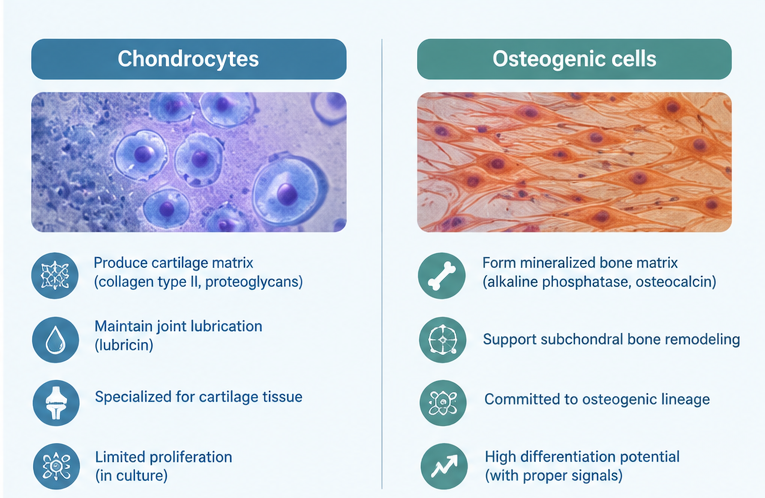
Chondrocytes are specialized for cartilage. Osteogenic cells, including osteoblast-lineage cells, are specialized for bone formation. MSCs are broader, less tissue-specific cells that may influence several components of the joint through differentiation and, importantly, through paracrine and immunomodulatory mechanisms.
This does not mean that chondrocytes and osteogenic cells have already replaced MSC therapy. MSCs currently have a much larger clinical evidence base, especially for intra-articular treatment of knee osteoarthritis. However, the idea of combining tissue-specific cells is becoming an important direction in osteochondral tissue engineering. Orthopedics & Joint Disorders
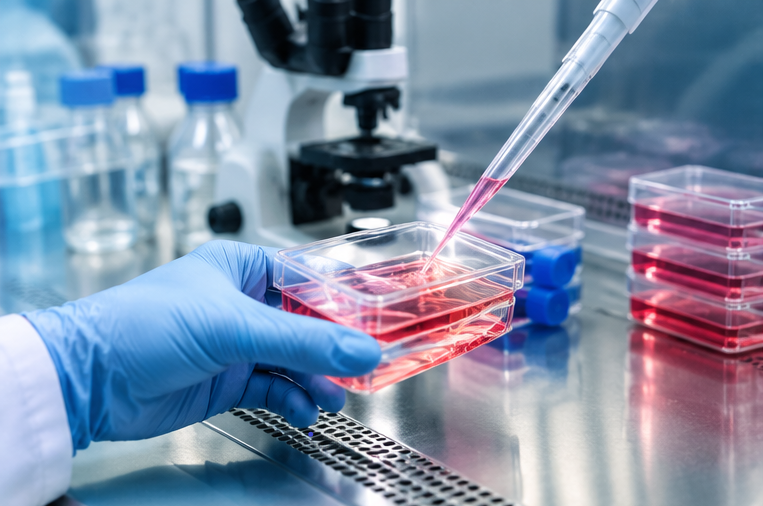
Why the joint may need more than one type of cell
A joint is not simply a piece of cartilage inside a capsule.
Articular cartilage sits directly above a specialized region of bone called the subchondral bone. Between them is a highly organized osteochondral interface. Synovial tissue, ligaments, menisci, muscles and the mechanical environment surrounding the joint also influence how the disease develops.
This matters because cartilage and bone have very different biological properties.
Cartilage contains chondrocytes and a specialized extracellular matrix designed to withstand repeated compression and low-friction movement. Subchondral bone contains osteoblast-lineage cells and a mineralized matrix designed to provide structural support and distribute mechanical loads.
The two tissues are connected, but they are not interchangeable.
This is one of the central challenges in regenerative medicine: repairing cartilage alone may not fully restore an osteochondral unit, while stimulating bone formation without controlling its organization may also be undesirable.
Modern osteochondral tissue engineering therefore increasingly focuses on recreating the different biological and mechanical environments of cartilage and bone rather than treating them as one uniform tissue.
MSCs: the versatile cell approach
MSCs remain one of the most extensively investigated cell populations in regenerative orthopedics.
They can be obtained from several tissues, including bone marrow, adipose tissue and synovial tissue. Depending on the environment, MSCs can interact with local cells and extracellular matrix and can exhibit osteogenic or chondrogenic differentiation potential.
However, their potential benefits may extend beyond simply becoming new cartilage or bone cells.
MSCs can release signaling molecules and extracellular vesicles and influence inflammatory and immune pathways. This has led to the idea that some of their clinical effects may result from modifying the joint environment rather than simply replacing damaged tissue.
Human studies have reported improvements in pain and function after intra-articular MSC treatment in some groups of patients. A 2026 systematic review and meta-analysis of randomized controlled trials found improvements in several pain and functional outcomes, although the results varied between studies and MRI-based structural improvement was not consistently demonstrated. Local reactions such as injection-site pain and joint swelling were also more frequent in the MSC groups in that analysis.
This distinction is important.
Clinical improvement does not automatically mean that damaged cartilage has been completely regenerated.
A patient may feel better because inflammation, pain signaling, synovial activity or the mechanical environment has changed, even when imaging does not show major structural restoration.
That is one reason researchers continue to investigate more tissue-specific approaches.
Chondrocytes: cells designed for cartilage
Chondrocytes are the natural cells of articular cartilage.
Their main biological role is maintaining the cartilage extracellular matrix, including components such as collagen and proteoglycans that give cartilage its unique mechanical properties.
This makes chondrocytes an intuitive choice for cartilage repair.
Unlike MSCs, which are multipotent stromal/progenitor cells with broader biological effects, chondrocytes are already specialized toward the cartilage phenotype.
This concept is not entirely new. Autologous chondrocyte implantation and related matrix-associated approaches have been investigated clinically for focal cartilage defects, particularly in the knee. Systematic reviews have compared chondrocyte-based approaches with MSC-based treatments for focal chondral defects, although the evidence remains heterogeneous and the optimal strategy depends strongly on the type and extent of the lesion.
The main challenge is that mature chondrocytes are not an unlimited resource.
They must be obtained from cartilage, isolated, expanded or otherwise prepared, and then maintained in a state that preserves the desired cartilage phenotype. During laboratory expansion, chondrocytes can undergo changes known as dedifferentiation, potentially reducing their ability to behave like native articular cartilage cells. How stem cells can eliminate knee pain
So while chondrocytes are highly attractive from a biological perspective, their clinical and manufacturing complexity has encouraged researchers to investigate alternative cell sources, including MSCs and tissue-engineered constructs.
Osteogenic cells: why bone matters in joint regeneration
When people hear about cartilage regeneration, they often focus almost entirely on the cartilage surface.
But the bone immediately beneath it is extremely important.
The subchondral bone helps distribute mechanical forces through the joint and interacts biologically with the cartilage above it. Changes in subchondral bone remodeling are an important part of osteoarthritis biology.
This creates an interesting therapeutic question:
If cartilage and subchondral bone are both affected, should regeneration focus on cartilage alone?
Osteogenic cells offer a possible answer.
Osteoblasts and other osteogenic cells are specialized toward bone formation. In osteochondral tissue engineering, they have therefore been investigated as a tissue-specific cellular component for the subchondral bone region, while chondrocytes are used for the cartilage region.
But there is an important scientific warning here.
The goal is not simply to create more bone.
In osteoarthritis, abnormal subchondral bone remodeling and sclerosis can themselves contribute to disease progression. Uncontrolled stimulation of bone formation would therefore not necessarily be beneficial.
The real objective is much more precise:
restore appropriate bone structure and function in the correct location and in the correct relationship with the cartilage above it.
This is why the term osteochondral regeneration is more meaningful than simply “bone regeneration.”
The idea behind combining stem cell joint regeneration- chondrocytes and osteogenic cells
This is where the concept becomes particularly interesting.
Imagine an osteochondral defect as a two-layer problem.
The upper component contains damaged cartilage.
The deeper component contains damaged or abnormal subchondral bone.
Instead of asking one cell population to solve both problems, researchers can consider a tissue-specific strategy:
Chondrocytes → cartilage regeneration
Osteogenic cells → subchondral bone regeneration
Together → reconstruction of the osteochondral unit
This concept is already present in tissue-engineering research. Reviews of osteochondral repair describe both tissue-specific cells and progenitor cells as potential cellular resources, with chondrocytes being particularly relevant to cartilage and osteoblast-lineage cells to subchondral bone.
The idea sounds simple, but the biology is not.
Cartilage and bone cannot simply be placed next to each other without considering the interface between them. Natural osteochondral tissue has gradients in cell phenotype, extracellular matrix, mineralization, mechanical properties and signaling molecules.
That is why modern research increasingly explores multiphasic and gradient scaffolds rather than simple one-layer implants. These constructs attempt to create different microenvironments for cartilage and bone while maintaining an organized transition between them. Stem Cell Therapy for Hip Osteoarthritis
Why this could be different from an MSC-only strategy
The potential advantage is not that specialized cells are automatically “better” than MSCs.
It is that they may be more precisely matched to the tissue being repaired.
MSCs can be thought of as a versatile biological platform. They may influence inflammation, cell signaling, extracellular matrix remodeling and tissue repair, while also possessing differentiation potential.
Chondrocytes are more specialized toward cartilage.
Osteogenic cells are more specialized toward bone.
This leads to a simple regenerative medicine principle:
Match the cell to the tissue.
For a generalized inflammatory joint environment, MSCs may be attractive because of their broad biological activity.
For a clearly defined cartilage defect, chondrocytes may offer a more tissue-specific strategy.
For a combined cartilage-and-subchondral-bone defect, a coordinated osteochondral approach could theoretically address both components.
The challenge is turning this elegant biological concept into a safe, reproducible and clinically effective treatment.
MSCs versus tissue-specific cells
| Approach | Main biological role | Main target | Current status |
|---|---|---|---|
| MSCs | Broad regenerative, signaling and immunomodulatory effects | Joint environment and multiple tissues | Most clinically studied |
| Chondrocytes | Cartilage-specific matrix production | Articular cartilage | Established research and clinical concept for selected focal defects |
| Osteogenic cells | Bone formation and remodeling | Subchondral bone | Туц Tissue-engineering use |
| Chondrocytes + osteogenic cells | Tissue-specific osteochondral regeneration | Cartilage + subchondral bone | Promising emerging strategy |
This table also shows why it would be premature to describe osteogenic cells plus chondrocytes as a proven replacement for MSC therapy.
The scientific question is not yet “Which treatment has won?”
It is:
Which cellular strategy is most appropriate for a particular type of joint damage?
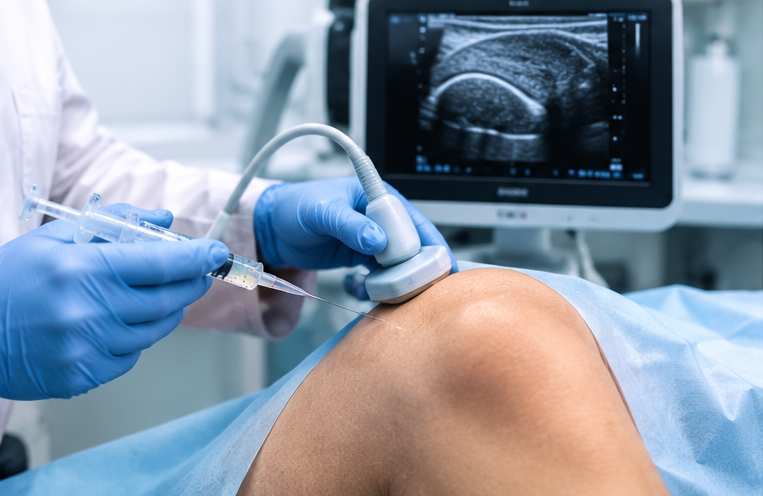
Could this approach be delivered as an injection?
This is where patient expectations need to be realistic.
MSCs have frequently been studied as intra-articular injections because the joint cavity provides a relatively accessible local treatment environment.
A tissue-specific osteochondral strategy is more complicated.
If the clinical problem is a small focal cartilage defect, a cell-based implant or matrix-associated approach may make more biological sense than simply placing cells into the joint fluid.
If both cartilage and subchondral bone are involved, a structured osteochondral construct may be considered in experimental settings.
In other words, chondrocytes plus osteogenic cells should not automatically be interpreted as “an injection containing two cell types.”
The cells may need to be positioned in specific regions and supported by a suitable biomaterial or scaffold.
This is one reason osteochondral regeneration is closely connected with biomaterials, scaffolds, hydrogels and increasingly sophisticated tissue-engineering systems. Multiphasic scaffolds are being investigated specifically because cartilage and bone require different environments while still needing to integrate with one another.
Why scaffolds may be important
A scaffold is not simply a passive piece of material.
In regenerative medicine, it can act as a temporary three-dimensional environment that helps cells attach, survive, organize and interact with surrounding tissue.
For osteochondral repair, this becomes particularly important because the desired tissue is structurally complex.
A cartilage layer needs a cartilage-like environment.
A bone layer needs a bone-compatible environment.
The interface between them also needs to be stable.
Researchers are therefore developing multiphasic, gradient and bioactive scaffolds designed to reproduce some of the natural differences between cartilage and subchondral bone. Some newer approaches even explore three-dimensional bioprinting and spatial placement of different cellular components. These technologies remain largely within the research and translational-development space rather than representing routine treatment for osteoarthritis.
Which patients could potentially benefit?
The concept of tissue-specific osteochondral regeneration may be particularly interesting for patients with defined osteochondral defects, where damage is localized and both cartilage and underlying bone are involved.
It may also have potential in joint-preservation strategies following certain injuries.
This is different from advanced, diffuse osteoarthritis.
In advanced osteoarthritis, the problem is usually not a single hole that needs to be filled. The joint may have widespread cartilage degeneration, changes in subchondral bone, synovial inflammation, altered mechanics and other structural abnormalities.
A sophisticated cellular implant cannot simply reverse every component of a chronically damaged joint.
That distinction is important because regenerative medicine is sometimes presented as though every form of arthritis is caused by the same biological problem.
It is not.
What does the evidence say today about stem cell joint regeneration?
The evidence currently supports a cautious but interesting conclusion.
Multiple clinical studies and systematic reviews have investigated intra-articular MSC treatment for knee osteoarthritis and focal cartilage disease. Results suggest that some patients experience improvements in pain and function, but study protocols vary considerably, and consistent structural regeneration on imaging has not yet been established.
Chondrocyte-based treatments have their own clinical history, especially for selected focal cartilage defects.
By contrast, combining chondrocytes with osteogenic cells to reconstruct the entire osteochondral unit is a more experimental concept. Much of the evidence comes from tissue engineering, biomaterials, animal models and laboratory studies rather than large clinical trials.
That does not make the concept unimportant.
It simply means that biological plausibility should not be confused with proven clinical efficacy.
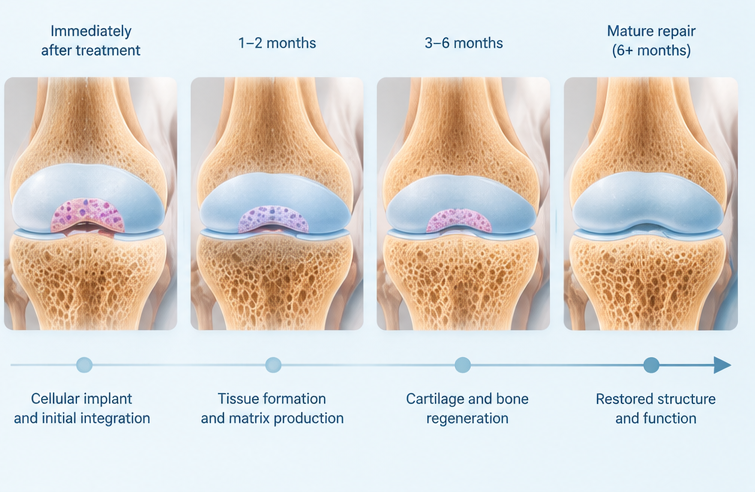
The potential advantages of a tissue-specific strategy
The most interesting potential advantage is precision.
A tissue-specific approach could theoretically provide:
Better biological matching — cartilage cells are directed toward cartilage, while osteogenic cells are directed toward bone.
Spatial organization — different cell populations can potentially be placed in the region where they are biologically most useful.
More controlled tissue formation — instead of asking a versatile cell population to respond to a complex environment, the therapeutic design can provide more specific cellular functions.
Better osteochondral reconstruction — the ultimate goal is not only a smoother cartilage surface but restoration of the relationship between cartilage and subchondral bone.
Compatibility with biomaterials — different cellular populations can potentially be incorporated into multiphasic scaffolds designed for specific tissue zones.
These are promising advantages, but they remain potential advantages until supported by robust clinical evidence.
The challenges researchers still need to solve
The biology is only one part of the problem.
Researchers must also determine which cells should be used, how they should be prepared, how their phenotype can be maintained, whether they should be autologous or allogeneic, how they should be positioned, and how the regenerated tissue can integrate with the patient's native cartilage and bone.
Chondrocytes present particular challenges because of their limited availability and the possibility of phenotype changes during cell expansion.
Osteogenic cells create a different concern: uncontrolled or poorly organized bone formation would not necessarily improve joint function.
And even a perfectly designed cellular product cannot overcome abnormal joint mechanics indefinitely.
For this reason, successful regenerative medicine will probably require more than cells alone.
Cells + biomaterials + biological signals + mechanical environment may ultimately be more important than any single component.
The future may not be one “perfect” stem cell
The biggest lesson from osteochondral research may be that regenerative medicine does not necessarily need to find one universal cell that can repair everything.
The human joint is too complex for such a simple solution.
A more sophisticated model is emerging:
use the right biological tool for the right tissue.
MSCs may remain valuable because of their broad regenerative and immunomodulatory properties.
Chondrocytes may remain important when the primary target is articular cartilage.
Osteogenic cells may become useful in carefully designed strategies targeting subchondral bone.
And combinations of these cells, supported by advanced biomaterials, may eventually allow researchers to reconstruct more complex osteochondral defects.
This is already reflected in the development of multiphasic scaffolds, gradient biomaterials and engineered osteochondral constructs designed to reproduce the distinct environments of cartilage and bone.
What patients should know
For patients, the most important message is simple:
A promising cell type is not automatically a proven treatment.
MSC therapy currently has the largest clinical literature among these approaches, but even MSC treatment remains an area of active investigation, with substantial differences between studies.
Chondrocyte-based therapies are more tissue-specific and have established clinical applications for selected cartilage defects, but they are not a universal solution for osteoarthritis.
The combination of chondrocytes and osteogenic cells is scientifically exciting because it addresses the joint as an osteochondral organ rather than treating cartilage and bone as unrelated problems. However, much of this work remains experimental.
The best future treatment may therefore not be the one containing the greatest number of cells.
It may be the one that provides the right cells, in the right place, with the right biological signals, and with the right mechanical support.
The bigger picture
The field of regenerative orthopedics is gradually moving away from the idea that a damaged joint can be repaired simply by introducing a generic population of stem cells.
The next generation of therapies may be more precise.
Instead of asking:
“Which stem cells should we inject?”
researchers may increasingly ask:
“Which tissue is damaged, what cellular function is missing, and how can we recreate the architecture of the joint?”
That change in thinking is important.
For cartilage, the answer may involve chondrocytes or cells capable of producing a stable cartilage phenotype.
For subchondral bone, osteogenic cells may have a role.
For complex defects, combinations of specialized cells, biomaterials and biological signals may ultimately be required.
MSCs will likely remain an important part of this field. But they may become one component of a broader regenerative strategy rather than the universal answer to every joint problem.
The most exciting future may therefore lie beyond MSCs — not by abandoning them, but by learning when a more tissue-specific cellular strategy makes biological sense.
The goal is not simply to add cells to a joint. The goal is to rebuild the right tissue, in the right place, with the right architecture.
Selected scientific literature
- Awad G, Saad J-P, Hamyeh A, Boutros M. Efficacy and safety of intra-articular mesenchymal stem cell-based therapies in knee osteoarthritis: A systematic review and meta-analysis of randomized controlled trials. Clinical Rheumatology. 2026.
- Strategies for osteochondral repair: Focus on scaffolds.
- Bioinspired gradient scaffolds for osteochondral tissue engineering.
- Multiphasic scaffolds for the repair of osteochondral defects: Outcomes of preclinical studies.
- Scaffold-Based Tissue Engineering Strategies for Osteochondral Repair.
- Material-Assisted Strategies for Osteochondral Defect Repair.
- Autologous Chondrocyte Implantation and Mesenchymal Stem Cells for the Treatments of Chondral Defects of the Knee — A Systematic Review.
- The Use of Autologous Chondrocyte and Mesenchymal Stem Cell Implants for the Treatment of Focal Chondral Defects in Human Knee Joints — A Systematic Review and Meta-Analysis.